December 2nd 2025
Donald Trump has recently claimed that he needs to save Nigerian Christians suffering in the north of the country. The statement is dramatic and emotionally charged, but it raises an important question. Is Trump genuinely concerned about the killing of Christians in Nigeria, or is the country becoming a convenient stage for political messaging aimed at audiences far from Abuja or Kaduna?
To understand this, we need to begin with why Nigeria matters within the 47th president’s worldview. Nigeria has the largest population on the African continent, with around 239 million people today and a projected 400 million by 2050. This puts it on track to become the world’s third most populous nation. It is also one of Africa’s economic giants, boasting one of the continent’s largest GDPs. Nigeria is not a peripheral country. It carries demographic weight, economic potential and regional influence.
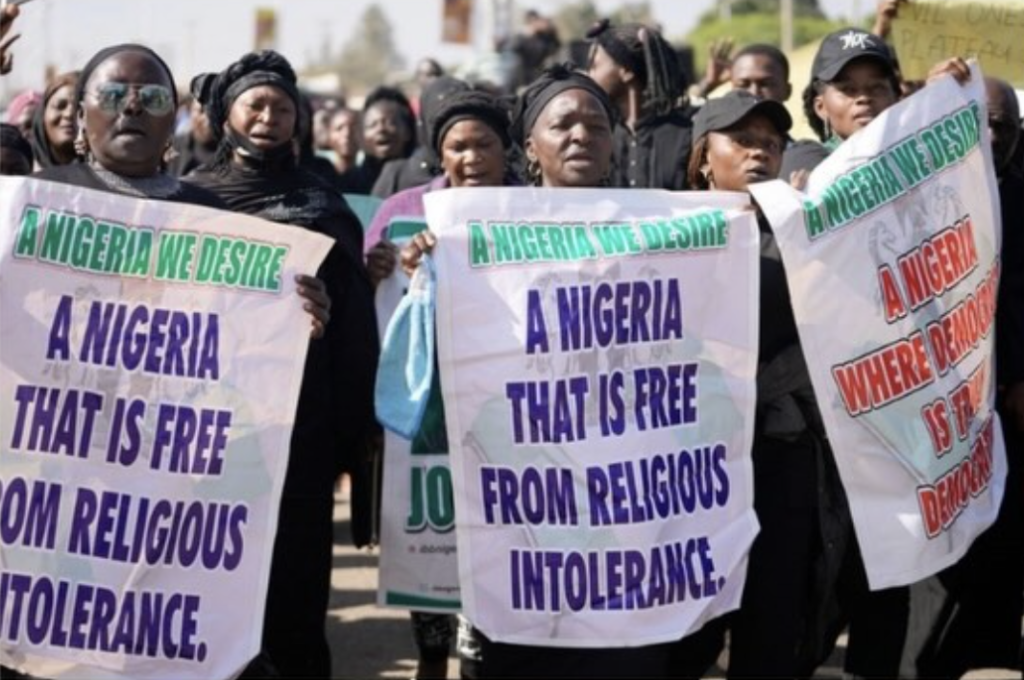
Trump’s focus on Christian persecution taps into Nigeria’s complex religious landscape. The country is often described as split roughly in half between Christians and Muslims, with the north predominantly Muslim and the south largely Christian. Yet Trump’s narrative flattens this complexity. The Fulani, a largely Muslim pastoral group, have clashed violently with Christian farming communities, but these conflicts are driven by land pressure, climate change, cattle migration and weak state authority, not simply religious hatred. The Boko Haram and ISWAP insurgencies have also carried out horrific violence, including attacks on Christians, yet they have killed more Muslims overall. Northern insecurity is rooted in poverty, state neglect and environmental stress, making the situation far more complicated than a straightforward religious war. By framing Nigeria’s problems as Muslims killing Christians, Trump oversimplifies a crisis shaped by multiple intersecting factors.
So why has Trump chosen Nigeria as the latest nation in need of his supposed protection?
The most important reason lies not in Nigeria but in American politics. Trump’s most loyal constituency is white evangelical Christians, a group that places strong emphasis on global persecution of Christians. Nigeria regularly appears in evangelical media as a symbol of Christian suffering, often with the nuance and context removed. By presenting himself as the defender of Nigerian Christians, Trump taps into the fears and moral concerns of this voting bloc. His framing allows him to energise supporters, strengthen identity based politics and position himself as a moral figure acting on behalf of persecuted believers.
In reality, Trump’s renewed focus on Nigeria is less about helping Nigerians and more about reinforcing a political narrative that resonates with his voters. Nigeria becomes a symbol, a talking point, a piece of political theatre. The suffering of real Nigerians is reshaped into a message that benefits Trump domestically. The humanitarian language masks a political calculation. For Trump, Nigeria is not a crisis to be understood but an opportunity to be used.
There are also deeper geopolitical motives beneath the humanitarian framing. Nigeria plays a major role in the new scramble for Africa. Both China and the United States have sought trade deals, energy partnerships and infrastructure investments across the country. China currently appears to have the upper hand, funding railways, roads, energy projects and offering large loans. A Nigeria aligned with China strengthens Beijing’s influence in Africa. By promoting a narrative of instability, the United States gains a moral justification to increase involvement in the region. Suggesting troop deployment gives Washington a reason to claim a stronger presence under the guise of humanitarian responsibility.
A second motive lies in Trump’s ideological worldview. He often frames global politics as a struggle between Christianity and hostile forces. On the surface, Nigeria fits this pattern. Christian communities in the north have been victims of violence. Yet this simplified framing hides the deeper causes of insecurity. For Trump, Nigeria becomes another example used to strengthen his political messaging on immigration, extremism and foreign policy. The narrative is useful, even when it ignores the complexity of Nigerian realities.
A final motive is economic. Nigeria’s oil and gas industries carry major global influence. A Nigeria that aligns more closely with the United States would support American energy security, benefiting sectors such as industry and technology. Humanitarian concern can therefore act as a cover for strategic economic interests.
The key issue with Trump’s rhetoric is that it misinterprets and simplifies Nigeria’s problems, risking greater tension. He reduces complex conflicts into two opposing religious identities. He ignores Nigerian sovereignty and overlooks the fact that Nigerian civil society leaders and religious figures reject foreign military intervention. His claims of sending troops are unrealistic and symbolic, transforming Nigeria into an American prop rather than respecting its political complexity.
It is true that Christian communities in northern Nigeria have faced targeted attacks and that their suffering deserves attention. But Trump’s approach does not offer solutions. It provides overgeneralisations that reflect American political narratives rather than Nigerian realities.
In the end, Trump’s recent comments reveal more about American political dynamics than about Nigeria’s security challenges. His rhetoric offers false hope to those who genuinely need support while using Nigeria as terrain for ideological battles. The humanitarian language masks domestic, geopolitical and economic motives, raising the question of whether Trump is seeking to save Christians or to save influence.
It is true that Christian communities in northern Nigeria have faced targeted attacks, and that their suffering deserves international attention. But Trump’s approach does not offer solutions. It offers over-generalizations that fit American political narratives rather than Nigerian realities.
So, in final analysis trumps recent comments reveal more about American political dynamics and pandering to the need of his voter bases rather than the Nigerian security giving a false hope to those who really need it. Furthermore, it allows Nigeria to become a terrain for American ideological battles. Finally, the carefully used humanitarian language and the emotional appeal well masks domestic, geopolitical and economic motives.
Written by Tola Ajayi