November 16th 2026
In under three weeks, a student blockade outside one Saint-Denis lycée became France’s largest youth movement in a generation. How did teenagers without leaders manage to build a national movement?
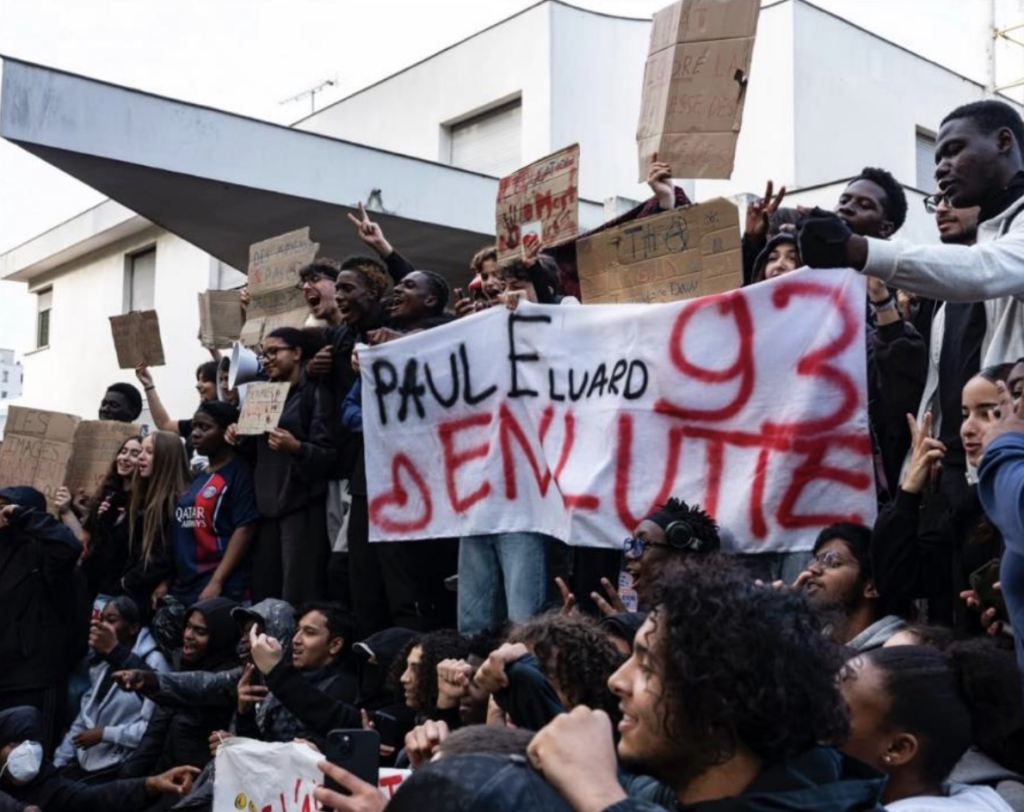
Student “blocus” at Lycée Paul-Eluard. Source : @Tulyppe on Instagram
The movement started in late September at the Lycée Saint-Exupéry in Creteil. Within days, it reached Seine Saint-Denis and Paul-Eluard high school which quickly became the movement’s emblem. Students blocked the gates, holding signs and chanting for better education infrastructure and funding.
The demands were concrete, not ideologically nor politically motivated: missing teachers and staff, unsanitary infrastructure, overloaded timetables, budget cuts, and the stress caused via Parcoursup. The 2027 budget plans to remove around 1,588 teaching jobs and, above all, students have claimed that discussion between them and the Ministry of Education was impossible. A banner in Montpellier summed it up: “We do our homeworks, time to do yours”.
From Saint-Denis to the Nation
By October, the movement was national, with close to 500 actions recorded in high schools. Central Paris followed the suburbs: on 2 October, students blocked Lycée Voltaire, widely known for previous student-led protests. Some students blocked in solidarity with the suburbs, others because they shared the same grievances. On 6 October, classes were disrupted in 891 of France’s 3,700 lycées (AFP). No party, no union, no political leaders called for the first blockades. Calls spread on social media, often from anonymous accounts: @mala.idf or a high school’s own social media page run by students. Posters and signs highlight Gen Z-coded humour and irony. One, painted as a vape, carried the brand “JNR” as “VNR” (angry), the flavour “Revolution givrée” and a “1312%” battery sign, a known code for “ACAB”.
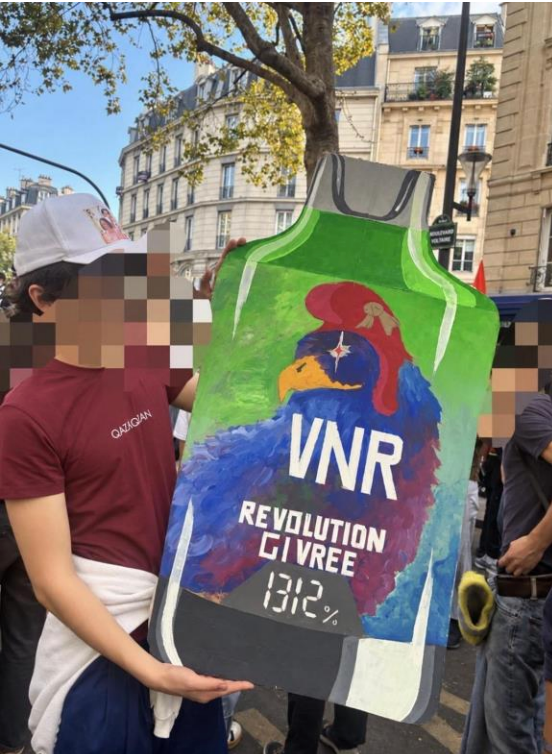
A placard painted as a vape at a march in Paris. Photo: Anonymous
The government’s main response fed the anger. They accused the left of instrumentalising the youth. For many students, this proved their points: Gen Z is not being heard. Then the violence escalated. Parts of several schools were set on fire. By 2 October more than 5,000 people had been arrested, 85% of them being minors (Amnesty). In Lens, a 15-year-old student lost his hand to a police grenade. L’IGPN (police watchdog) opened 18 investigations, and stun grenades were originally banned at student protests (Public Sénat).
17th of October
Everything came from a social media post calling for multiple mobilisations across France on the 17th of October. The movement had its biggest day: 800,000 marchers according to the organisers, with students alongside workers and gilets jaunes. At night the protests already under tension turned into violent riots in the streets of Paris, where multiple shops were broken into and looted by masked individuals. In Limoges radical activist set fire to the Town hall leaving the community deeply shocked.
Over the weekend, mainstream media replayed the same footage of riots and unrest on a loop, drowning out the students’ demands. Police violence against minors got far less coverage. Across France, students began asking a harder question: when the state and its institutions use violence, is violence in return ever legitimate?
The Movement in Costume
On Saturday 31 October, the movement marched again on Halloween. Student and workers marched side by side in “Acte III” against the cost of living, thus showing that the students anger spread to everyone. In Paris, the courts banned the symbolic Bastille-Nation route and moved the march out near the city’s suburbs. The interior Minister counted 320,000 protesters, unions claimed 500,000 (BFM TV). The mood was more Halloween than revolution. Protesters came dressed as spiderman, Mobutu, pirates, with dance battles and a band. Authorities were nervous, police warnedthat Halloween masks would make it hard to tell costumes from rioters. The marches stayed largely calmed and festive, though a gendarme was hit by a Molotov cocktail in Paris.
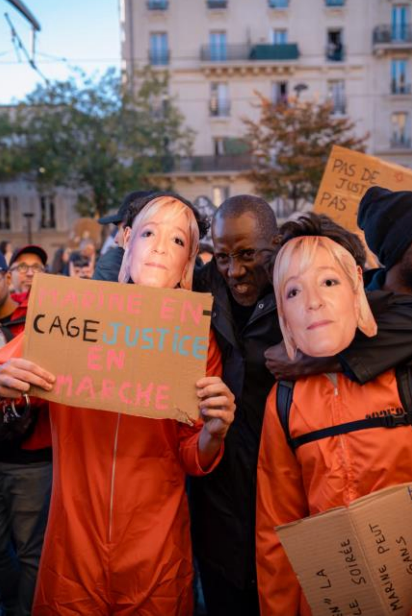
Protesters dressed as Marine Le Pen posing with Saint-Denis Mayor Bally Bagayoko. Photo: Anonymous
Six months before a presidential election, a generation often called apathetic has learned to organise without leaders. With a general strike called for 5 November, the question is no longer whether Gen Z can mobilise, but whether anyone will answer its demands.
Written by Martin Pallu De Beaupuy
Sources
AFP / Paris Match, “Mouvement lycéen en France : plus de 250 000 manifestants”, 6 Oct 2026
Public Sénat, “Blocus des lycées : dix-huit enquêtes IGPN ouvertes”, 7 Oct 2026
BFM TV (via Shango), “422 interpellations, des cortèges revendicatifs calmes… Laurent Nuñez tire son bilan des manifestations du 31 octobre”
Amnesty International France, “Mouvement lycéen : des mineurs face à la répression des forces de l’ordre”